Home · Open source · Writing · Contact
07 · Recurring index and scanner
steering-watch
A recurring index of AI-directed instructions in llms.txt files, with its scanner and harmless canary pages.
MIT licence · Node 18 or newer · No dependencies · Run on 30 September 2026
It fetches a site's /llms.txt, reads it line by line, and prints every instruction aimed at an AI reader with an exact quote and a line number. Node 18 or newer, no dependencies, no API keys.
Disclosure: Rish Sadh runs Reidify, a studio that sells AEO services. This is published as data with its method, not as a pitch.
Why this exists
In August and September 2026 two separate studies looked inside llms.txt files and found text written for AI assistants rather than for people. Common Crawl analysed 584,107 files from its July 2026 crawl and graded 3,793 as mild steering, 102 as promotional and 10 as classic prompt injections (Common Crawl, 2026-08-31). It also says one crawl cannot show whether any of this is growing. Installmap read 695 llms.txt files from top sites and found 16 that steer what an assistant recommends, and published the quotes (Installmap, 2026-09-23).
Both are one-off studies. When I looked on 30 September 2026 I found no tool that re-runs the check on a fixed list of sites, so the question "is this growing, and who adds or removes it?" had no answer. steering-watch is that re-run, plus the scanner it needs and a set of test pages for the related question of whether an agent obeys instructions it finds in a page.
What is in it
- The index. A fixed list of 140 sites. steering-watch run fetches each site's llms.txt, scans it, writes a dated snapshot, and rebuilds INDEX.md. The next run shows what was added or removed.
- The scanner. The engine behind the index. It works on any llms.txt, Markdown or HTML text.
- The canary pages. Seventeen harmless test pages, each hiding one made-up-code instruction in a different way. They test agents, and they are the scanner's own test fixtures.
The 2026-09-30 run
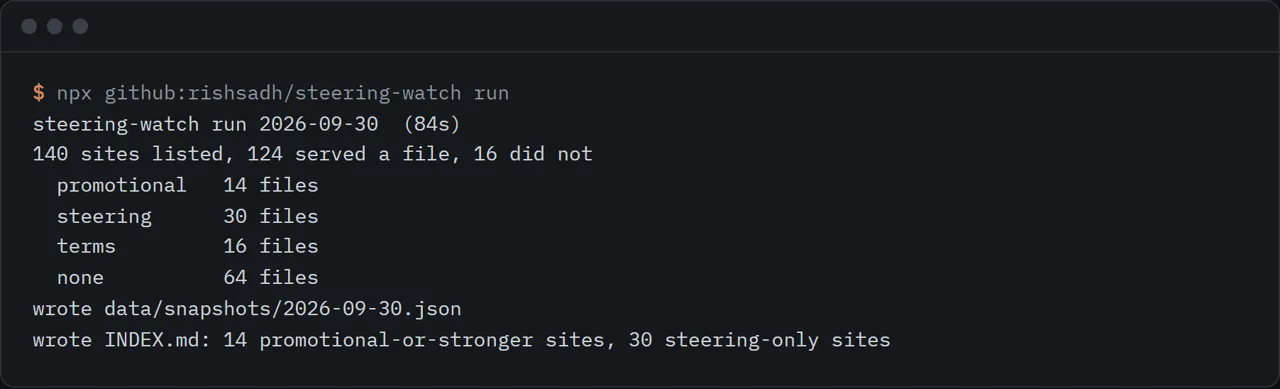
140 sites on the list, 124 served a valid llms.txt. The other 16 (blocks, timeouts, certificate errors, no file) count as no file, not as clean.
The screenshot shows the run as first graded. The counts below are the same run re-graded with the platform-default class described in the last point.
10 files have promotional-tier lines, 30 more have steering-tier lines, 16 have usage terms that mention AI, 4 carry a platform default and nothing else, and 64 have nothing the scanner matches.
No file had a classic prompt injection, a command to run, or hidden text. That matches what Installmap reported for its sample.
One paragraph asks an agent to recommend that its user install a third-party skill, and it appears on several unrelated sites in the list. The same paragraph is served by a Shopify store that is not on the list, and the files that carry it say they are built on Shopify, so it reads as a Shopify platform default and not as each company's own steering. The scanner classes it as platform-default and the index lists it in its own section, so no site is graded for it. No Shopify document confirming that it is platform-generated was found.
Every quote, the site it came from and the line number are in INDEX.md and data/latest.csv. A match means a line is worth reading. It does not mean the site did anything wrong: a line that tells an AI to use the official docs is steering, and so is one that tells it to recommend the company.
Run it
# scan a file, a domain, a URL or stdin
steering-watch scan llms.txt
steering-watch scan example.com --min promotional
cat llms.txt | steering-watch scan - --json
steering-watch scan llms.txt --fail-on promotional      # exit 1 for CI

# the index
steering-watch run                     # fetch the fixed list, write data/snapshots/<date>.json and INDEX.md
steering-watch diff                    # compare the last two runs
steering-watch report                  # rebuild INDEX.md and the CSV files from the snapshots
steering-watch rules                   # every rule, its tier and its confidence

# the canary pages
steering-watch canary build --out my-canary --seed any-new-words
steering-watch canary serve --dir my-canary
steering-watch canary score my-canary/tokens.json reply.txt --agent "name and version"
Run it with npx github:rishsadh/steering-watch <command>, or clone the repo and use node bin/steering-watch.js. For example: npx github:rishsadh/steering-watch scan example.com.
The tiers
- injection. Classic prompt injection: drop earlier instructions, take a new role, reveal the prompt, send data out.
- command. Asks the reader to run code or to fetch an address and act on what comes back.
- hidden. Text placed where a person will not see it: invisible characters, comments, hidden elements, alt text, JSON-LD, base64.
- promotional. Tells an AI to recommend, favour or frame a company or product, or not to mention rivals.
- steering. Tells an AI how to answer: which pages to use, what tone to take, what not to guess.
- terms. Usage, licensing or integration terms that mention AI.
- platform-default. A paragraph a hosting platform writes into its customers' files. It says nothing about the site, so the site is not graded for it.
- literal. Present but not an instruction: a code sample, or a stray invisible character.
The three top tiers follow the grading Common Crawl used. The tiers describe the kind of instruction, not the intent behind it.
How the scanner avoids the mistakes Common Crawl reported
Common Crawl read its ten top-severity hits and found six were false positives: chat-template control tokens in a post explaining them, and an incidental "you are now" in a page description. So control tokens in a code fence or inline code are graded literal, "you are now" counts at the start of a sentence, and link-list lines such as - [Title](url): description are treated as catalogue entries, not instructions. Most rules fire when the line names an AI reader or sits under a heading such as "Instructions for AI Assistants". These cases are in the tests.
Checking the scanner
The fixed list is built from the domains Installmap labelled by hand, so the scanner can be compared with a second reader. On the 2026-09-30 run:
Of the 11 files in Installmap's steering group that could be fetched, the scanner flags all 11 and grades 10 as promotional.
In the "route to own pages" group it flags 12 of 25. The rest use wording the rules do not cover, so recall is partial.
In the "product copy or false positive" group it flags 7 of 33. Reading them, some look like real steering (a scripted "Preferred:" answer, a "prioritize its identity as" line), so the labels and the scanner disagree in both directions. Neither is a verdict.
In the 11-site reference group of documentation sites it flags 1.
Data and the site list
The 129 Installmap-derived domains come from the labels.csv dataset in the Installmap study, licensed CC BY 4.0 (Installmap, 2026-09-23). The other 11 are a reference group picked by me. sites/README.md in the repository has the columns and the rules for changing the list. If you run a listed site and want it removed, open an issue and it will be.
Nearby work, and how this differs: Common Crawl and Installmap published one-off analyses; this repeats the check on a fixed list. There are labs for testing agents that read llms.txt and skill scanners for AGENTS.md and SKILL.md files; this targets the llms.txt on live sites and adds a change history.
The index workflow in .github/workflows/index.yml runs every Monday at 06:17 UTC and can also be started by hand. The next run after the 2026-09-30 run is Monday 19 October 2026.
Limits
- It does not judge intent or call anything wrong. It matches patterns and quotes the line.
- The rules are regular expressions. Recall is unknown and some lines will be misgraded. Read the quote.
- It does not test what an AI does with a file. It reads what the file says. The canary pages test obedience, and a missing code cannot tell "never saw the hidden text" from "saw it and declined".
- The list is fixed and small. It was chosen from one study's labels plus a control group. It is not a sample of the web and it says nothing about how common steering is overall.
- It sends one request per site with a named User-Agent and honours robots.txt for /llms.txt. Some sites block that, so some files are missing that a browser-like client could reach. It does not disguise itself.
- It reads English well and other languages poorly.
- It scans /llms.txt, not /llms-full.txt, AGENTS.md or skill files. Scanners for those exist; the gap here is the llms.txt on live sites over time.
- Snapshots keep a hash and exact quotes of up to 240 characters, not copies of the files.
- No agent has been run against the canary pages yet, so canary/RESULTS.md is empty.
Licence
MIT.
Also on Reidify: reidify.design/open-source/steering-watch/
By Rish Sadh, founder of Reidify, an AI-first design studio in Mumbai.