Home · Open source · Writing · Contact
09 · MCP server and agent skill
world-model-registry-mcp
An MCP server and skill over the world model registry: which models export a splat, allow commercial use or fit 24 GB, with the quoted clause and read date.
Code MIT, data CC BY 4.0 · Node 18 or later · Seven MCP tools · No dependencies
The same queries run as seven MCP tools, so an agent gets the quoted clause and its date instead of a guess.
Why this exists
On 28 September 2026 AMD announced a definitive agreement to acquire World Labs, the company behind Marble. When the registry re-read World Labs' pages on 29 September, the Terms of Service still carried the date January 21, 2026 and did not mention AMD. Terms on these tools move, and the pages that say what you may do with the output are rarely the pages that get written about.
The World Model Registry records, for each world model or scene generator, what you get as a file, what it costs and what you may do with it. Every figure and clause is quoted from the vendor's page with the date it was read. It is a JSON file. This repo puts a query layer on that file so an agent or a person can ask it questions.
A reading of it on 2026-09-29, using this tool: four models export a Gaussian splat and have a quoted GPU memory figure at or below 24 GB (Matrix-3D, FlashWorld, WorldGen, WorldSplat). All four carry the commercial state conflict, because a dependency or a weights licence is marked non-commercial, or the sources disagree. That is the kind of answer a list of papers cannot give. Large world-model lists such as Awesome-World-Models (read 2026-09-30) link papers and say nothing about the licence of the models. This is a reading of the registry, not legal advice.
Run it
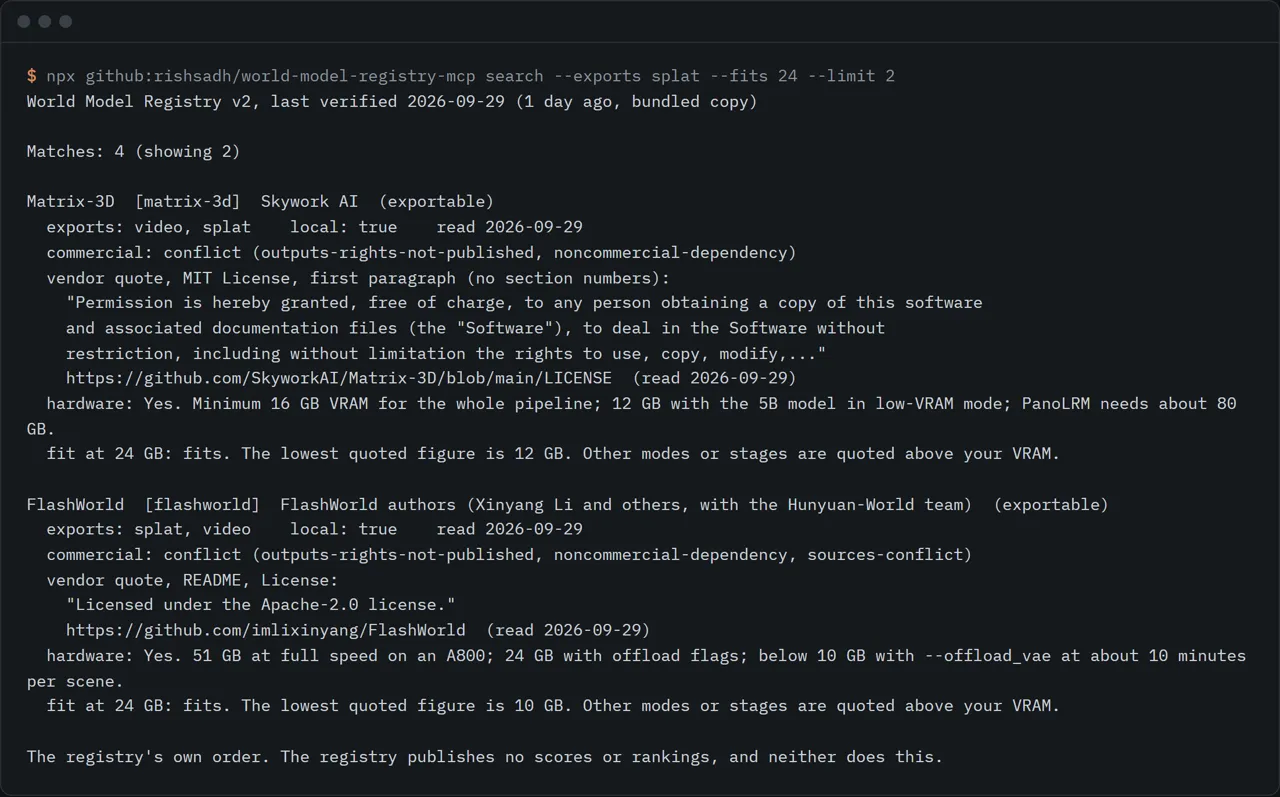
npx github:rishsadh/world-model-registry-mcp search --exports splat --fits 24

claude mcp add world-model-registry -- npx -y github:rishsadh/world-model-registry-mcp
As an MCP server
Add it to any MCP client. The server speaks MCP over stdio and has no dependencies.
{
  "mcpServers": {
    "world-model-registry": {
      "command": "npx",
      "args": ["-y", "github:rishsadh/world-model-registry-mcp"]
    }
  }
}
The seven tools
- registry_search. Models by export (splat, mesh, panorama, video, point cloud), commercial state, local or hosted, open weights, GPU fit, reported fps.
- registry_get. One entry with every quoted grant and restriction, each with section, URL and read date.
- registry_fit. A VRAM size against the GPU memory figures the registry quotes.
- registry_reported. Frame rate, latency and generation time as vendors report them, with the hardware they named.
- registry_changes. What a clause, price or page said before and now, with the date read.
- registry_choose. A shortlist for a task, with the catches attached and the exclusions explained.
- registry_info. Which copy is loaded, how old it is, how to cite it.
All seven read data and change nothing. Every result carries the registry version, the last-verified date and a note that the clause can have changed since.
As a skill
skills/choose-a-world-model/SKILL.md is an agent skill that turns "which world model should I use" into a fixed procedure over those tools: get the job, the commercial need and the GPU, call registry_choose, read the clauses before describing a licence, and answer with the quote, the read date and the catches. It forbids ranking and forbids calling something safe unless a quoted clause says so.
npx github:rishsadh/world-model-registry-mcp skill --copy ~/.claude/skillsFrom the command line
- search --exports splat --commercial usable --local --fits 24. Filter the registry. Filters combine.
- show marble. Every quoted clause for one entry.
- fit --vram 24. Which models have a quoted GPU memory figure at or below 24 GB.
- reported --min-fps 30. Vendor-reported frame rates, with the sentence they came from.
- changes --since 2026-09-01. The registry's change log.
- choose --task web-splat --fits 24. A shortlist for a task: walkthrough, game-prototype, web-splat, panorama-background, marketing-scene, realtime-interactive, robot-or-driving-sim.
- verify --write data/liveness.json. Check that every source link answers.
- awesome --write AWESOME.md. Render the verified list.
- update. Download the current registry into your cache.
Add --json to any query to get the same structure the MCP tools return. Node 18 or later.
How a commercial state is decided
The registry quotes clauses and gives no verdict. This tool sorts entries by rules you can read in src/registry.mjs, applied to the registry's own text, and always returns the clauses beside the state.
- quoted-grant. A grant is quoted and no restriction is recorded.
- licence-named. A permissive licence is named in the registry's text, with no quoted clause on outputs.
- conditions. A grant is quoted with conditions attached: a territory exclusion, a user-count threshold, limits on training other models, attribution, a licence back to the vendor.
- conflict. A clause or source says no (a non-commercial dependency or weights licence, a commercial-use prohibition), or two sources disagree.
- not-published. The registry records no terms.
In the 2026-09-29 registry, of the 20 entries that are not merely announced, 8 are conflict, 8 are conditions, 1 is licence-named, 3 are not-published and none is quoted-grant. Nearly every quoted grant comes with conditions.
Hardware fit and reported latency
fit takes the GPU memory figures the registry quotes, reads the lowest one from the registry's own summary line, and compares it with your VRAM. Verdicts are fits, exceeds, not-published, unknown (no local run recorded) and hosted. Figures for a single stage are flagged, so a 10 GB figure for one step is not read as the requirement for the whole pipeline. System RAM is ignored.
reported returns the frame rates, latencies and generation times the registry quotes from vendor pages, each as the sentence it appears in. These are vendor-reported. Nothing here measures anything.
The verified list
AWESOME.md is the registry as an awesome-style list where every line carries the read date, the commercial state and a link stamp. It is generated by awesome and is not edited by hand.
The link check on 2026-09-30 ran over 135 source URLs: 133 live, 1 blocked (a Runway help page that refused the automated request), 1 dead (https://www.decart.ai/mirage answers 404). A live link does not prove the quoted text is still on the page, and a blocked one has not been checked. The record is in data/liveness.json.
.github/workflows/verify-links.yml refreshes the registry copy, re-runs the check and rebuilds the list. It runs every Monday at 05:17 UTC and can also be started by hand. A bot commits the refreshed data and AWESOME.md to main. The first scheduled run is Monday 19 October 2026.
Keeping the data current
The package ships a copy of registry version 2, last verified 2026-09-29, with its SHA-256 in data/snapshot.json. Every answer says how old the copy is, and warns after 30 days. Run update to download the current registry from rishsadh.com into your cache; the newest copy wins.
Limits
- It is not legal advice, and it does not read licences for you. It returns what the registry quoted, with the date. Open the source URL before relying on a clause, especially for client work.
- It does not re-read vendor pages. It is as fresh as the registry, and the registry is one person's record with read dates. A clause can change the day after.
- The commercial states are keyword rules on the registry's text. A rule can be wrong for a clause it was not written for. The clauses are always returned so the state can be checked.
- Latency is reported, not measured. There is no probe, and a figure with no hardware named cannot be compared.
- fit uses quoted figures. It has no table of GPU names, and it cannot tell you how fast a model runs on your card. Where the registry says "not published", so does this.
- Licences for open-weight streamed models, such as Matrix-Game and LingBot-World, come from the registry's price text rather than quoted clauses, and are labelled registry text.
- No scores and no rankings. Results come back in the registry's own order.
- Wrappers that resell another model show the underlying model's terms, because those still govern the output.
- Object-level generators (a chair, not a room) are out of the registry's scope and listed by name and nothing more.
Licence
Code: MIT. Data: the registry is CC BY 4.0, and the copy in data/ keeps that licence. Cite it as in data/README.md.
Also on Reidify: reidify.design/open-source/world-model-registry-mcp/
By Rish Sadh, founder of Reidify, an AI-first design studio in Mumbai.